


Pulmonaria (Lungwort)
Lungwort brings fresh flowers to the shade garden as early as March, often pink and blue at once, above strikingly silver spotted foliage. It is hardy, bee friendly and returns year after year.
Showing 1 - 5 in 5 items
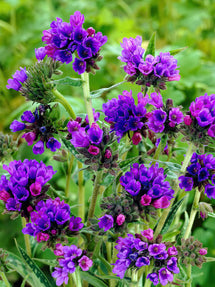
Lungwort (Pulmonaria): early flowers and silver foliage for shade
Lungwort is one of the very first perennials to flower each year. From as early as March it opens small, bell shaped blooms, many of them pink at first and then blue, so both colours glow on the plant at once. Add to that the striking, silver spotted foliage that stays handsome right through summer.
Lungwort grows from a hardy perennial that you plant in spring. Given a spot in partial shade to full shade, in humus rich, moist soil, it returns year after year and spreads into a dense, broad clump. As one of the earliest bloomers, it is a valuable food source for bumblebees and early bees.
Which lungwort suits you?
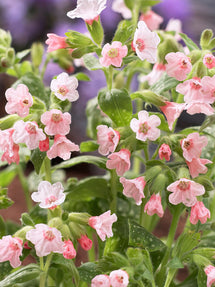
 Pierre's Pure PinkSalmon pink, bell shaped flowers above green, silver speckled leaves. Pierre's Pure Pink flowers in spring and stays low at 20 to 30 cm.
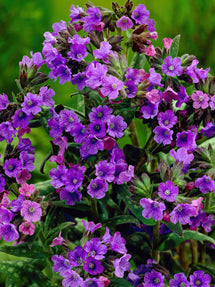
 Smokey BlueSmoky blue flowers that soften to pink as they age. Smokey Blue forms a low, spreading carpet of dark green, silver spotted leaves.
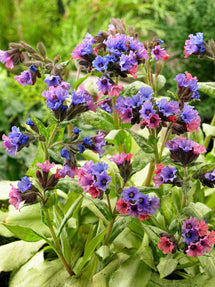
 EB AndersonRich blue flowers rising from red buds, also known as Bertram Anderson. EB Anderson has slender, silver flecked leaves and draws bees and butterflies.
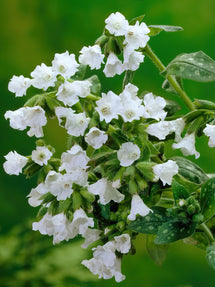
 Sissinghurst WhitePure white, funnel shaped flowers in early spring. Sissinghurst White carries bright green leaves with white spots that stay handsome into autumn.
 Silver BouquetGenerous silver leaf markings and flowers that open pink and mature to blue. Silver Bouquet is early flowering and lovely as ground cover or in a pot.
Flowering and the gardening year
Plant in spring, flowering from early in the season. Lungwort is one of the first perennials to bloom in the gardening year.
Position and soil
Lungwort is happiest in partial shade to full shade, at the edge of shrubs or beneath trees. Give it a humus rich soil that stays evenly moist and does not dry out in summer.
It dislikes hot afternoon sun and dry spots. If it stands too dry it lets its leaves droop and is more prone to powdery mildew. A little compost and a layer of mulch keep the soil pleasantly moist.
How to plant
- Plant in spring, in a spot in partial shade to full shade.
- Dig a generous hole and set the plant so the crown sits just below the surface.
- Space plants 30 to 40 cm apart; the clumps knit together over time.
- Firm the soil and water in well.
- Mulch around the plant to keep the soil moist.
Our tip: cut lungwort back hard after flowering. The old leaves can be removed entirely, because the plant quickly pushes out fresh, cleanly silver marked foliage that stays lovely into autumn. That way you get the early flowers for the bees first, and then a season of flawless leaves for the shade garden.
DutchGrown, specialists in flower bulbs and perennials since 1882Year after year
Lungwort is a hardy perennial. The clump returns reliably each spring and grows fuller from year to year. Spreading slowly on short runners, it forms a dense carpet in time that keeps weeds down.
Every few years you can lift and divide larger clumps in autumn to make new plants. This keeps them vigorous and gives you fresh specimens for other shady corners.
Lovely with
Lungwort belongs at the shady edge of the garden, among other early woodland perennials. It looks wonderful over the foliage of Hostas and beside the blue spring haze of Brunnera.
Just as fine with Bleeding Hearts and sweet scented Lily of the Valley, which love the same cool, humus rich soil.
Order now, plant in spring
You can order lungwort now. We ship the plants from March, in good time for spring planting.
Shipped fresh from the Netherlands, by a family business since 1882.
Frequently asked questions about lungwort
When does lungwort flower?
Lungwort is one of the first perennials to flower, usually from March to May. Just when little else is in bloom, it offers valuable nectar for early bumblebees and solitary bees.
Why do the flowers change colour?
On many varieties the flowers open pink and gradually turn blue. This colour change tells insects which blooms still carry nectar, and it gives you the pretty mix of pink and blue on a single plant.
What position does lungwort need?
It is happiest in partial shade to full shade, at the edge of shrubs or under trees, in a humus rich soil that stays evenly moist. It dislikes hot afternoon sun and dry spots, where the leaves soon wilt.
How tall does lungwort grow?
Lungwort stays low at around 20 to 30 cm and spreads into a dense, broad clump. That makes it an excellent ground cover for shade and a fine choice for the front of a border or a pot.
Is lungwort hardy?
Yes, lungwort is a hardy perennial that returns every spring. The clump grows larger over the years, and many varieties keep their silver marked foliage well into autumn.
How do I keep the silver foliage looking good?
Cut the leaves back after flowering and the plant pushes out fresh, cleanly marked foliage. Keep the soil evenly moist, since dry conditions make powdery mildew more likely on the leaves.
Is lungwort good for bees?
Very. As one of the earliest plants to flower, lungwort is an important food source for bumblebees and solitary bees that are active early in spring, when few other blooms are open.