


Siberian Iris (Iris Sibirica)
Siberian iris (Iris sibirica) brings slender, elegant flowers to the early summer garden on tall, grassy clumps, in blue, purple, yellow and warmer shades. It is one of the easiest irises to grow and one of the few that is happy in moist soil, even at the edge of a pond. Plant the bare roots in spring, and they come back fuller every year. Shipped from March.
Showing 1 - 12 in 12 items
Siberian iris: elegant flowers, almost no work
Siberian iris (Iris sibirica) is a hardy perennial with slender, grassy leaves and delicate flowers held on tall, upright stems. Each bloom has small upright petals, the standards, above wider drooping ones, the falls. Unlike bearded iris, it has no beard and no fuss.
It flowers in late spring and early summer, in blues, purples, yellows and warmer shades. Plant the bare roots in spring, give them moist soil, and they come back a little fuller every year.
Which Siberian iris?
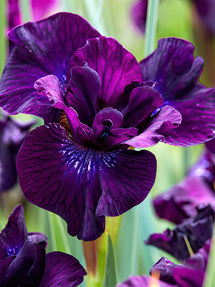
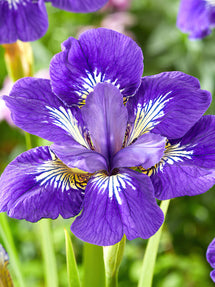
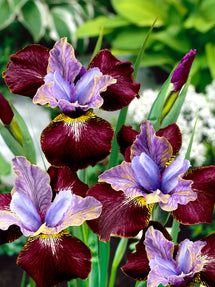
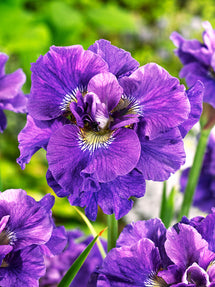
- 💜Deep purplesFor dark, dramatic colour, Purplelicious is one of the deepest purples there is, with Black Joker and the ultraviolet I See Stars close behind.
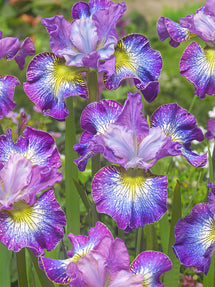
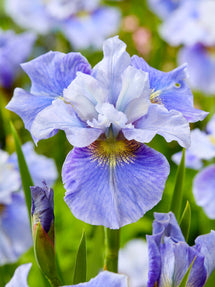
- 💙Soft bluesThe classic Siberian iris look. Mission Bay is a calm pale blue, while How Audacious mixes blue, lilac and pink and settles in happily by water.
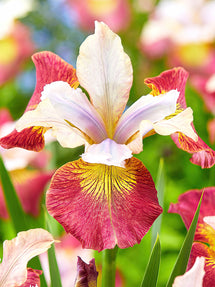
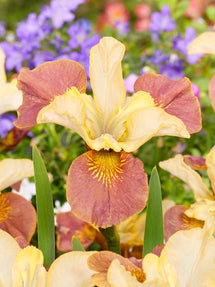
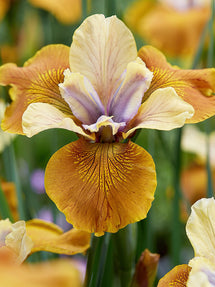
- 🧡Warm and unusualNot every iris is blue. Drink your Tea is apricot and cocoa, Sugar Rush is watermelon red with gold, and Colonel Mustard is a burnt yellow with lavender veins.
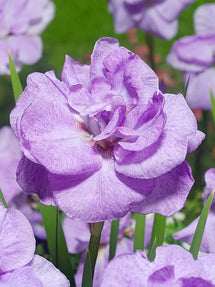
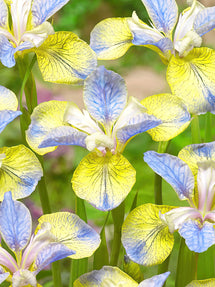
- 🌸Ruffled and doubleFor more petals, Concord Crush has full, double flowers in a rich violet blue, and Tipped in Blue pairs soft yellow with blue tipped petals.
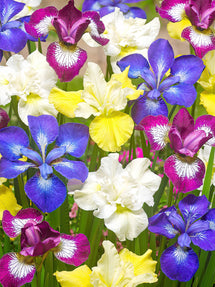
- 🌈One of eachCan't choose? The Breeders Mix gives you a spread of colours in one go, ideal for filling a longer border.
Siberian or bearded iris?
| Siberian iris | Bearded iris | |
|---|---|---|
| Flower | slender, beardless | large, with a fuzzy beard |
| Soil | moist, even damp | dry and well drained |
| Position | sun to light shade | full sun |
| Habit | grassy clumps | rhizomes on the surface |
| Care | leave it to settle | keep rhizomes sunbaked |
After the big, ruffled flowers that like it hot and dry? Those are the bearded irises.
Where to plant
Siberian iris is happy in full sun or light shade. What it really wants is soil that stays moist: fertile, humus rich ground that does not dry out in summer. Work in some compost before planting.
This is a good plant for the damp spots where many others sulk, like the edge of a pond or a low, wet corner. It also does fine in an ordinary border, as long as you water it through dry spells.
Planting bare roots
- Plant in spring, as soon as the ground is workable.
- Soak the bare roots in water for an hour or two before planting.
- Set the crown about 2 to 3 cm below the surface.
- Space the plants 45 to 60 cm apart. They fill out over a few years.
- Water well and keep the soil moist through the first season.
Best left alone
Siberian iris is long lived and does not like being disturbed. Once it is happy, leave it: it needs no lifting, no staking and very little feeding. Each year the clump gets a little wider and carries more flowers.
Only divide when the middle of the clump goes bare after many years. Do that in early autumn or early spring, cut back the leaves and replant the outer, healthy pieces straight away.
More than the flowers
The show does not end in summer. Leave the spent flowers and you get neat, dark seed pods that stand through autumn and into winter, lovely with frost and good in a dried arrangement. The flowers themselves last well in a vase.
Siberian iris sits beautifully with other plants that like the same moist soil, such as astilbe, hostas, daylilies and burnet.
Order now, plant in spring
You can order Siberian iris now. We send the bare root plants out from March, in good time for spring planting.
Frequently asked questions about Siberian iris
When do Siberian irises flower?
In late spring and early summer, usually from late May into June and sometimes on into July. Each clump flowers for a few weeks, and the seed pods that follow carry the display on into autumn.
Where should I plant Siberian iris?
In full sun or light shade, in soil that stays moist. Fertile, humus rich ground is ideal. It is one of the few irises that is happy in a damp spot, so it works well near a pond or in a low, wet corner.
What is the difference between Siberian and bearded iris?
Siberian iris has slender, beardless flowers and grassy foliage, and it likes moist soil and a bit of shade. Bearded iris has larger flowers with a fuzzy beard on the falls, grows from a rhizome that needs to bake in full sun, and wants dry, well drained soil. Siberian iris is the easier of the two in most gardens.
Are Siberian irises hardy?
Yes, fully hardy and long lived. They die back in winter and return a little stronger each spring. They need no winter protection.
Do Siberian irises spread?
They form slowly widening clumps rather than running about, so they are not invasive. After several years the centre of an old clump can go bare, and that is the moment to lift and divide it.
How do I plant bare root Siberian iris?
Soak the roots for an hour or two, then plant in spring with the crown about 2 to 3 cm below the surface. Space the plants 45 to 60 cm apart, water well and keep the soil moist through the first summer while they settle in.
Do Siberian irises grow in wet soil?
They cope with damp ground far better than most irises and are happy at the edge of a pond or stream. They do not want to sit in standing water all winter, and they also grow well in a normal border as long as it does not bake dry.
Are Siberian irises good cut flowers?
Yes, the flowers last well in a vase, and the dark seed pods that follow are just as useful in autumn and winter arrangements.
Are Siberian irises toxic?
The roots are mildly toxic and can upset the stomach of pets that chew them, and the sap can irritate sensitive skin. Wear gloves when you divide or handle the roots, and the plant is otherwise safe in the garden.