


Crocosmia (Montbretia)
Crocosmia sets the late summer border alight, arching out slender sprays of vivid red, orange and yellow funnel flowers above fans of sword shaped leaves. Hardy, sun loving and alive with bees and butterflies, it comes back in a bigger, bolder clump every year.
Showing 1 - 5 in 5 items
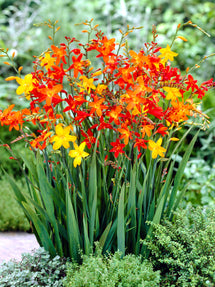
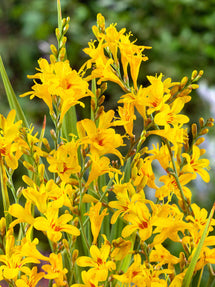
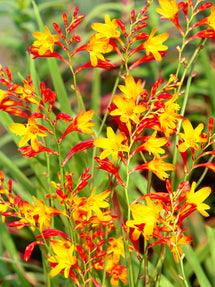
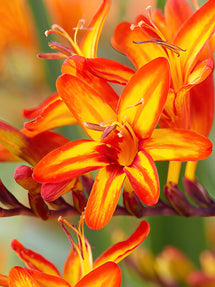
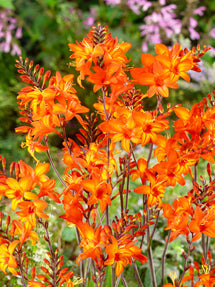
Crocosmia (Montbretia): fiery arching sprays for the late summer border
Crocosmia sets the late summer garden alight. From fans of upright, sword shaped leaves it arches out slender stems hung with rows of vivid, funnel shaped flowers in flame red, burning orange and golden yellow, opening in succession over weeks and buzzing with bees and butterflies.
Crocosmia grows from a small corm that you plant in spring. It loves a sunny spot, holds its colour through the hottest part of the year, and comes back in a bigger, bolder clump every season. For sheer fiery drama, the tall Firestarter is hard to beat.
Which crocosmia suits you?
 Firestars FirestarterPure fire. Firestarter is the tallest and boldest here, throwing arching sprays of large, flame orange and red flowers up to 120 cm above dark, bronze flushed sword leaves. A real showstopper for a hot, sunny border.
 MixThe whole fiery range in one planting. The Crocosmia Mix blends glowing reds, oranges and yellows, so a single drift gives you a shifting ribbon of warm colour through the second half of summer, alive with bees and butterflies.
 HarlequinPlayful and bright. Harlequin carries cheerful two tone flowers in red and gold, each bloom a little flag of warm colour on gracefully arching stems. Lovely for cutting and a magnet for pollinators.
 Hot SpotSunshine yellow. Hot Spot lights up the border with clear golden yellow funnels on arching sprays, a softer, sunnier note among the reds and oranges and a fine companion to hot colours and cool alike.
 Peach MelbaThe gentle one. Peach Melba trades fire for soft apricot and yellow tones, a prettier, more delicate crocosmia that blends beautifully into a warm pastel scheme while still drawing the bees.
Flowering and the gardening year
Plant the corms in spring, flowering through the second half of summer. The clumps thicken and flower more freely year by year.
Position and soil
Crocosmia wants full sun to light shade in a fertile soil that drains well but does not dry out completely. It is a classic plant for a hot, sunny border, a gravel garden or a bold group by a path.
It copes with most soils that are not waterlogged. Dig in a little compost before planting on poor, dry ground, and the corms will establish faster and flower more freely.
How to plant
- Plant the corms in spring, in sun to light shade.
- Set them about 8 to 10 cm deep, with the growing tip upwards.
- Space the corms about 10 cm apart, in bold groups.
- Firm the soil and water in well.
- Leave them to clump up for the best display.
Which way up, and how deep
A crocosmia corm has a pointed growing tip on top and roots below. Set it tip upwards, about 8 to 10 cm deep, and over the years it builds short vertical chains of corms as the clump expands.
Our tip: crocosmia rewards patience and a little neglect. Plant the corms in a generous group in a sunny spot and then leave them undisturbed to knit into a solid clump, which is when they flower most spectacularly. Only when a clump grows so congested that flowering starts to drop off is it worth lifting and dividing, in spring, replanting the plump top corms and discarding the shrivelled old ones from the base of the chain. And do cut a few arching stems for the vase, where they last beautifully.
DutchGrown, specialists in flower bulbs and perennials since 1882Year after year
Crocosmia is a hardy perennial that comes back and builds every year. Each corm makes new corms on top of itself, so the clump steadily widens and the flower display grows richer season by season with almost no effort from you.
After several years, if a very congested clump begins to flower less, lift and divide it in spring. Pull the corm chains apart, replant the fat top corms and water them in.
Lovely with
Crocosmia is the heart of the hot, sunny border, among other fiery late flowers. It blazes beautifully beside the bold blooms of Dahlias and the tall spikes of Gladiolus, which flower at the same time.
Just as fine with the nectar rich Coneflowers and bee loved Bee Balm, for a border that hums with pollinators all summer.
Order now, plant in spring
You can order crocosmia now. We ship the corms from March, in good time for spring planting, ready to set the border alight in late summer.
Shipped fresh from the Netherlands, by a family business since 1882.
Frequently asked questions about crocosmia
When does crocosmia flower?
Crocosmia flowers in the second half of summer, roughly from July into September. Its arching stems of fiery funnel shaped flowers open in succession over many weeks, bringing warm colour to the border just as early summer flowers are fading.
What makes crocosmia special?
The combination of fiery colour and graceful form. Sprays of vivid red, orange and yellow flowers arch out over fans of upright, sword shaped leaves, giving both bold colour and strong structure. The flowers are rich in nectar and a favourite of bees and butterflies.
What position and soil does crocosmia need?
Give it full sun to light shade in a fertile soil that is well drained but does not bake bone dry. It is happiest with sun on its flowers and a little moisture at the root, and it is a fine plant for a hot, sunny border or a gravel garden.
How tall does crocosmia grow?
Most reach around 50 to 70 cm, while the vigorous Firestarter can touch 120 cm. The taller sorts make a strong statement towards the middle of a border, their flower sprays arching elegantly out above the foliage.
Is crocosmia hardy and perennial?
Yes, crocosmia is a hardy perennial that grows from a corm and returns each year. The corms multiply and the clumps thicken over time, so the display grows more generous season by season. In very cold gardens, a winter mulch gives extra protection.
Does crocosmia spread, and is it invasive?
The named garden varieties here form well behaved, steadily expanding clumps rather than running. It is really only the old wild montbretia, Crocosmia crocosmiiflora, that can spread freely in mild areas. If a clump grows congested and flowers less, simply lift and divide it in spring.
Is crocosmia a good cut flower and good for wildlife?
On both counts, yes. The arching sprays are superb and long lasting in a vase, and the tubular flowers are rich in nectar, drawing bees and butterflies through late summer. In warmer climates they are even visited by hummingbirds.
Is crocosmia toxic?
Crocosmia is one of the more trouble free choices, generally regarded as non toxic and safe around people and pets. The dried flowers have even been used to make a mild, saffron scented tea. As with any plant, it is still not meant to be eaten.